Use the map below to explore the rooms of BeHere / 1942. Each location on the map leads to a text by Masaki Fujihata and the materials found in the physical exhibition space at the Japanese American National Museum.
-
Looking at a photograph is like exploring the ruins of an old building—each gives us a similar sort of pleasure.
-
One major shift that occurred in the field of European art at the beginning of the modern period was the emergence of mirrors as objects represented in paintings.
-
Things that cannot be understood from a single photograph in isolation become clearer when seen across multiple images, which gradually form a larger context and story.
-
How we think about the time and space of 1942 depends on the stance we adopt toward our engagement with the past. Do we enter that world as complete outsiders? As tourists? In conceiving a work like this, it is crucial to think about the role the visitor plays.
-
In 1942, the building that housed Nishi Hongwanji temple was located across the street from a block of warehouses, on East 1st Street and North Central Avenue. You can still see it there today, though now it is an annex of the Japanese American National Museum (JANM).

Looking at a photograph is like exploring the ruins of an old building—each gives us a similar sort of pleasure. In the case of ruins, though, the entrance is often obscured, power lines no longer anywhere to be found. Perhaps the floor has rotted out, the ceiling caved in, such that what life once existed there can only be imagined from the rubble that remains. In a photograph, at least, something definitive appears to us—a figure playing with a dog, a family eating a sliced-up apple: proof of real people who once really lived. But as the captured moment grows more and more distant with time, we lose sight of why the photograph was taken to begin with. It is here, faced with this limitation, that the The photograph serves as proof that not only its subject, but also the photographer behind the camera once existed. In this, too, it differs from architectural ruins. The photographer is almost always hidden from view, as if to say: “Don’t mind me, just look at what’s in the frame.” The moment viewers comprehend what it is they see in the photograph, however—the moment they stop imagining what might be there—they cease looking altogether. But what if we did not stop looking? My aim in this project was to peer deeply into photographs of the forced removal of Japanese Americans from Los Angeles in 1942, to derive from them something more than was visible on the surface.
My first epiphany came during a period when I was spending a lot of time zooming in on high-resolution scans made available to the public by various archives. The images were incredibly vivid, almost as though they had been photographed yesterday, in part because they had been scanned directly from the original negatives. You could see right down to the actual grains of silver halide, so naturally I found myself wanting to enlarge everything, to explore different areas of the scans. At one point, something struck me, and I enlarged the eyes of a young girl. In the photograph, the girl is looking straight into the camera, smiling. On her chest is a tag with a number identifying her family unit, indicating that she is being sent to a concentration camp. Like the adults around her, she is dressed in unusually formal attire—the sort of clothes one might wear on a special occasion. I might mistakenly have assumed she was going on a school field trip, had I not known that the year was 1942, and that the Japanese Americans behind her were waiting to be loaded onto a bus bound for a camp. Zooming in on her eyes, however, I noticed something peculiar: the silhouettes of five people. Five people … Presumably the one in the middle was the photographer, and then there was her assistant … but who were the other three? To think of this Japanese American girl standing there, smiling, with a group of five adults, all most likely white, forming a wall in front of her. Looking at her eyes so close up, I realized that she was not really smiling at all. A shiver ran up my spine.
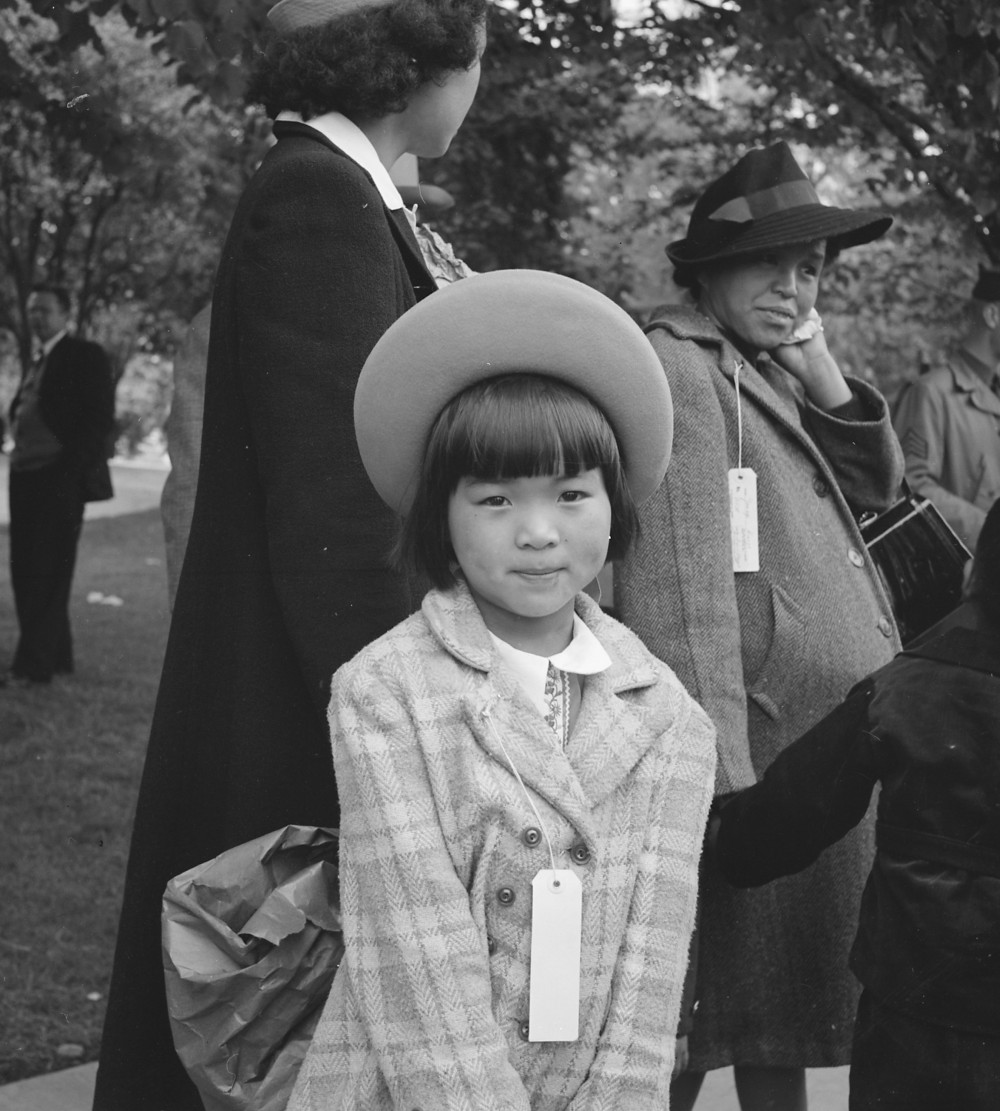
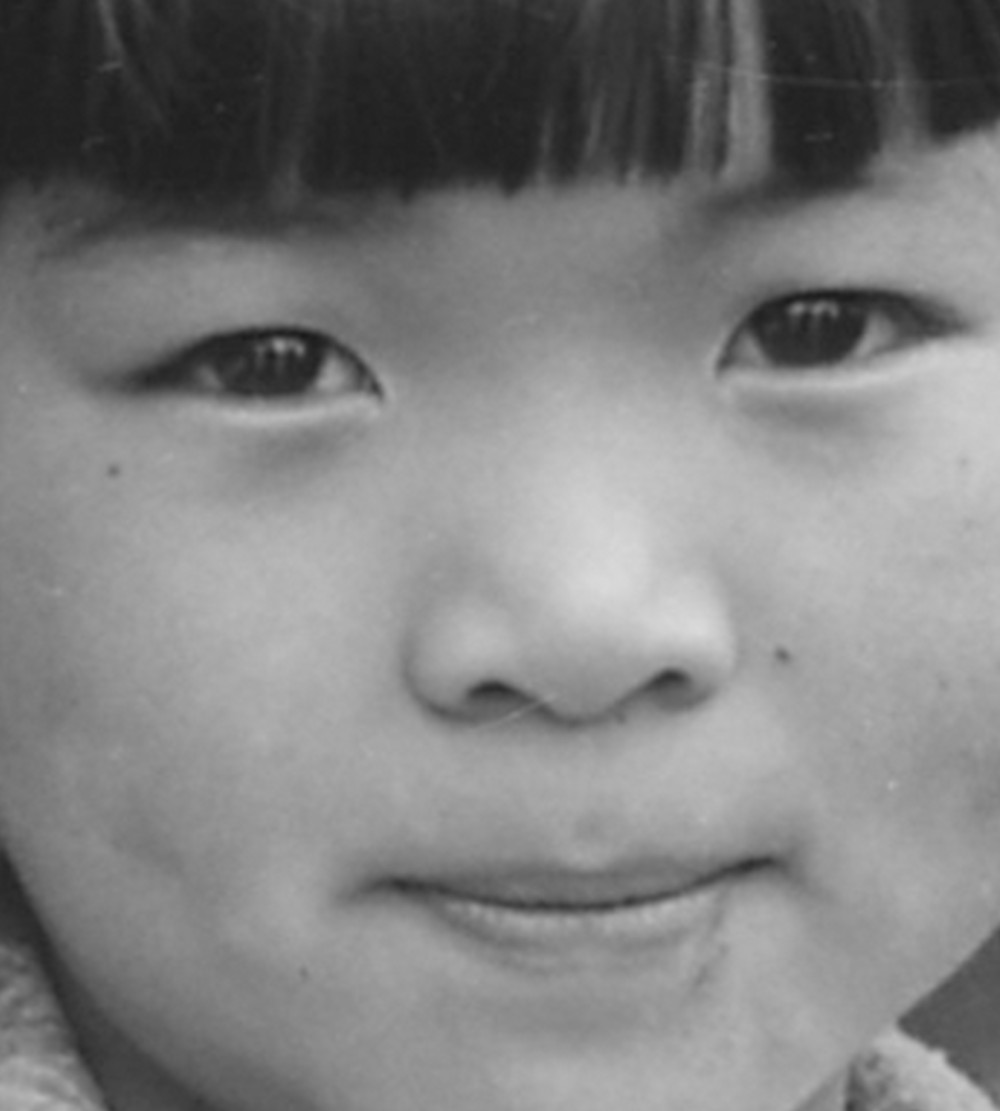
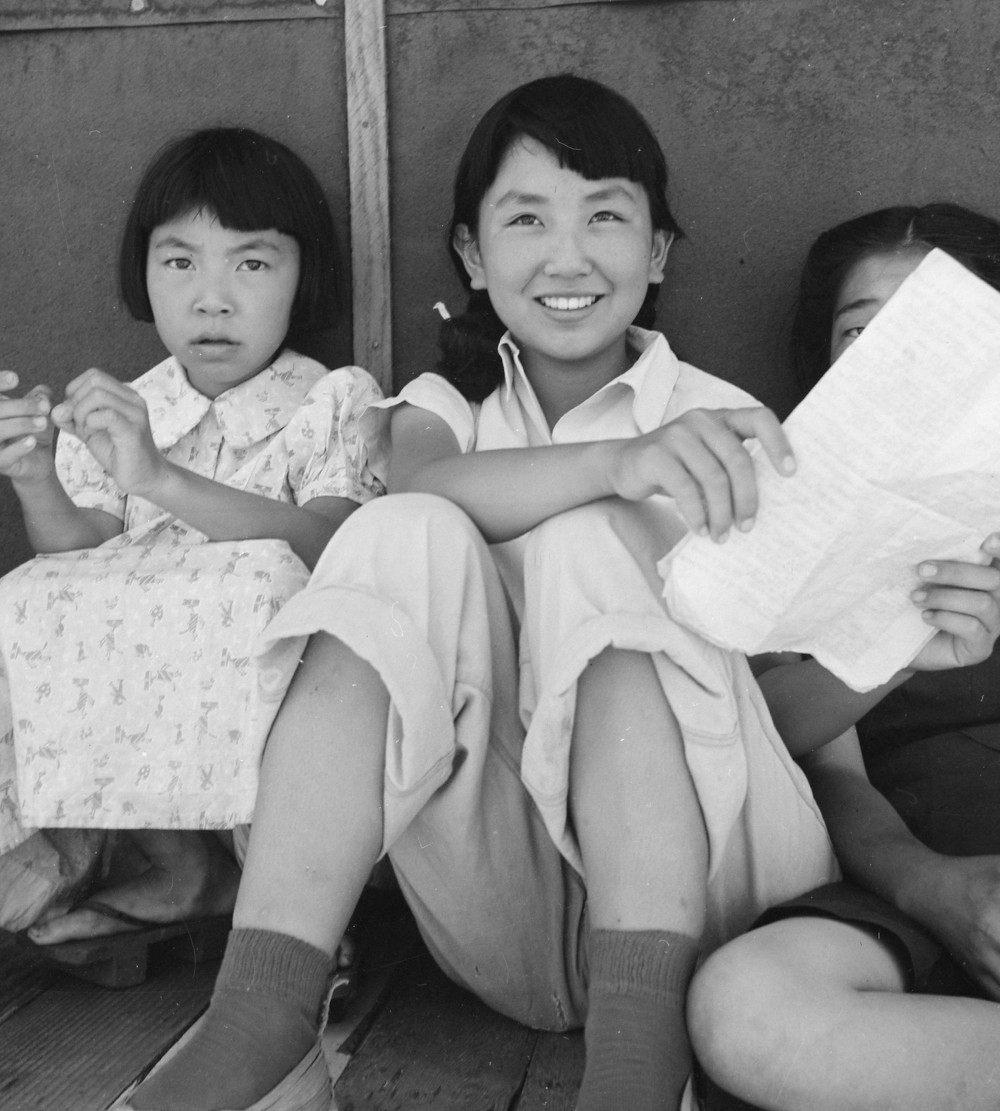
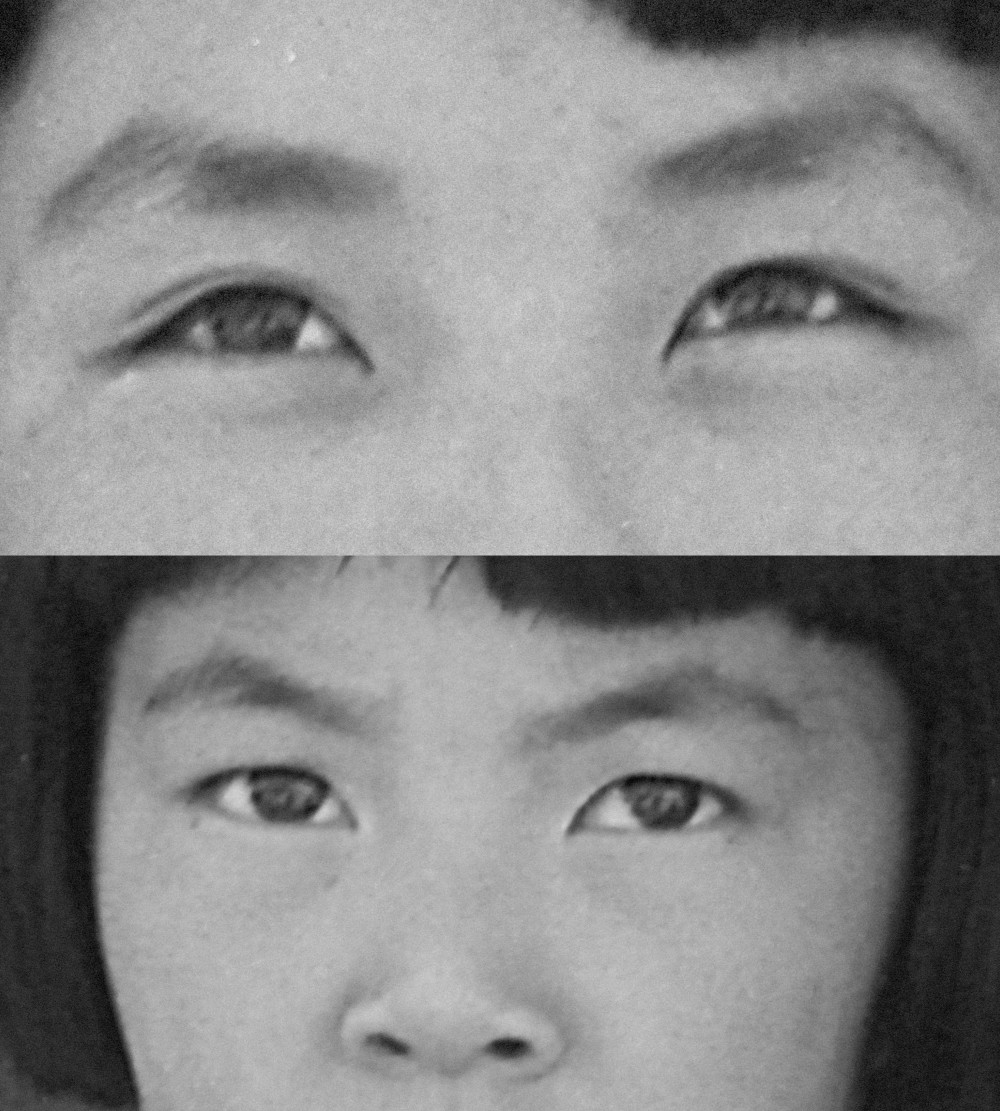
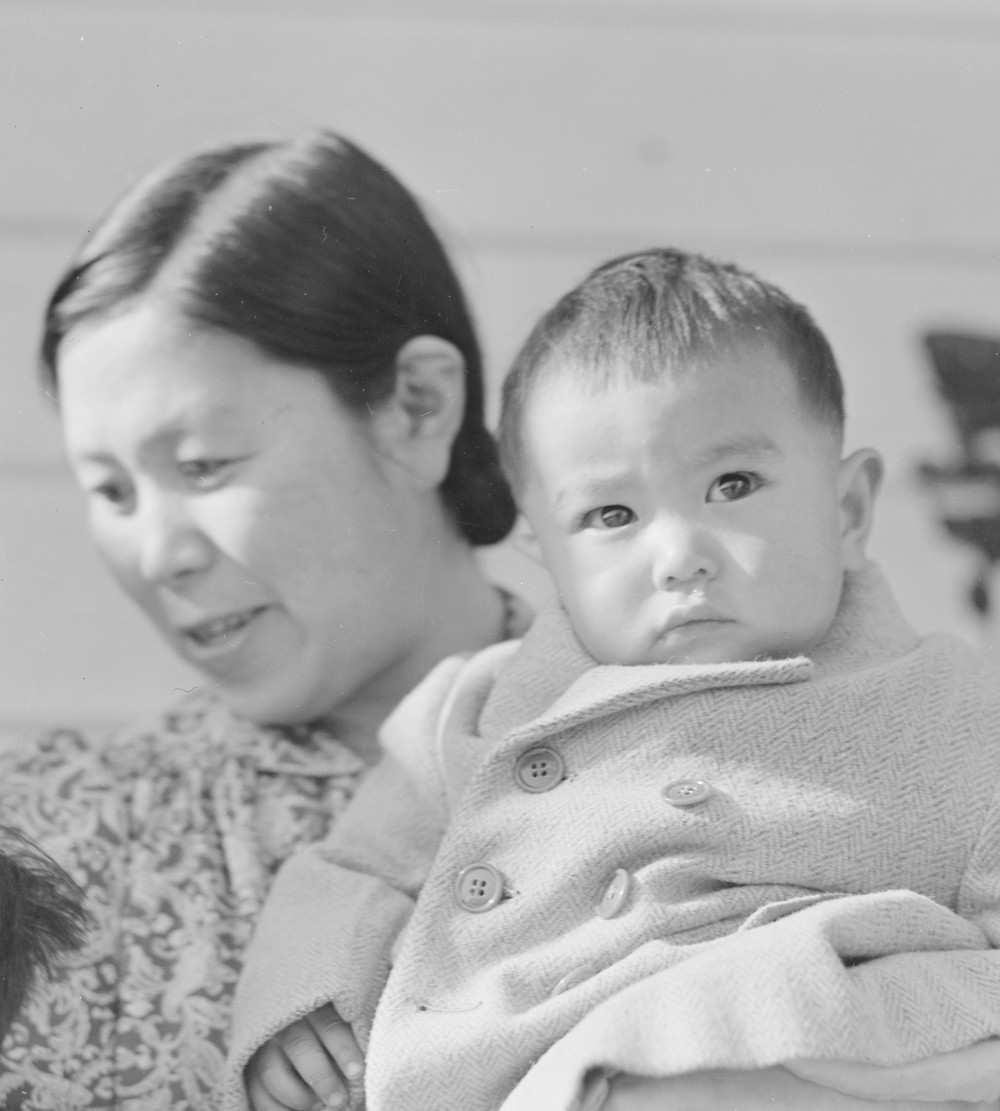
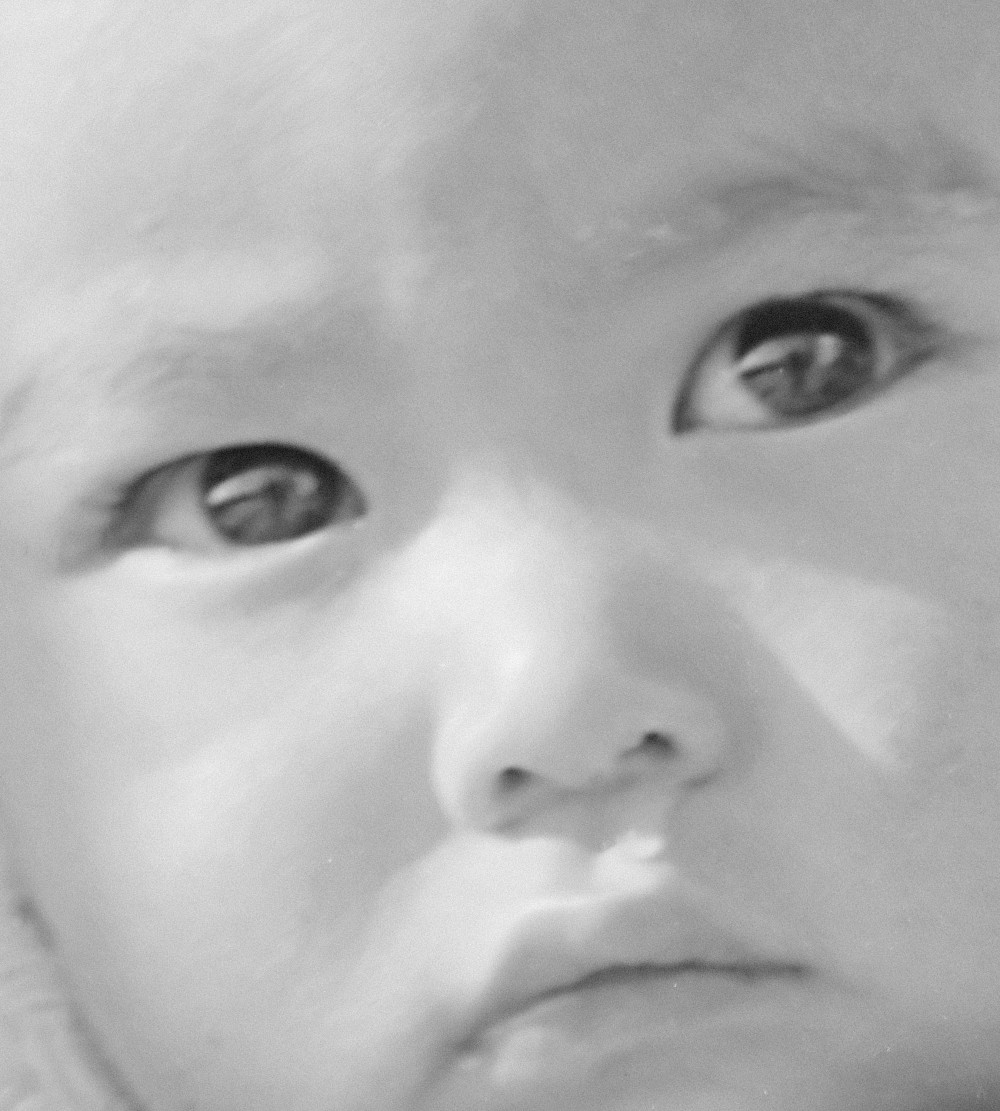
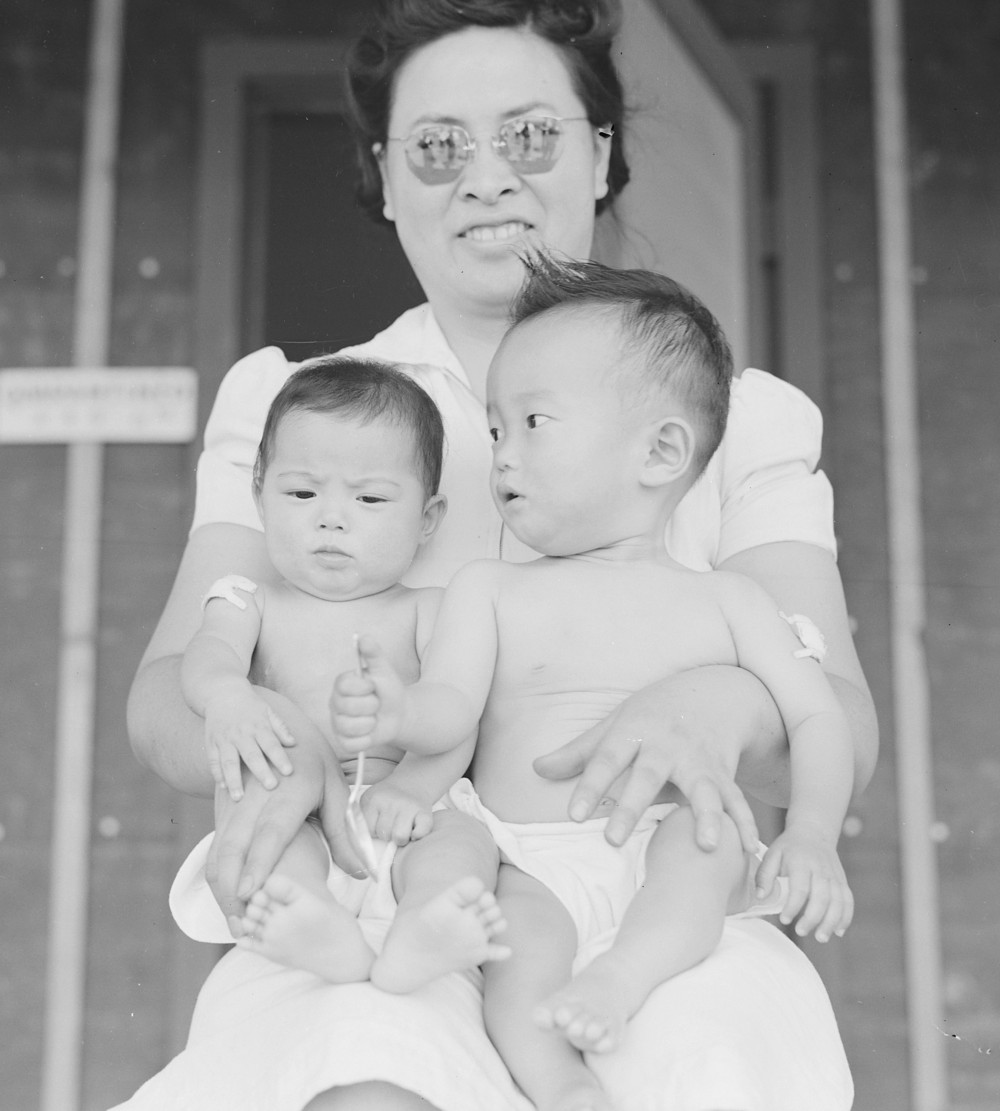
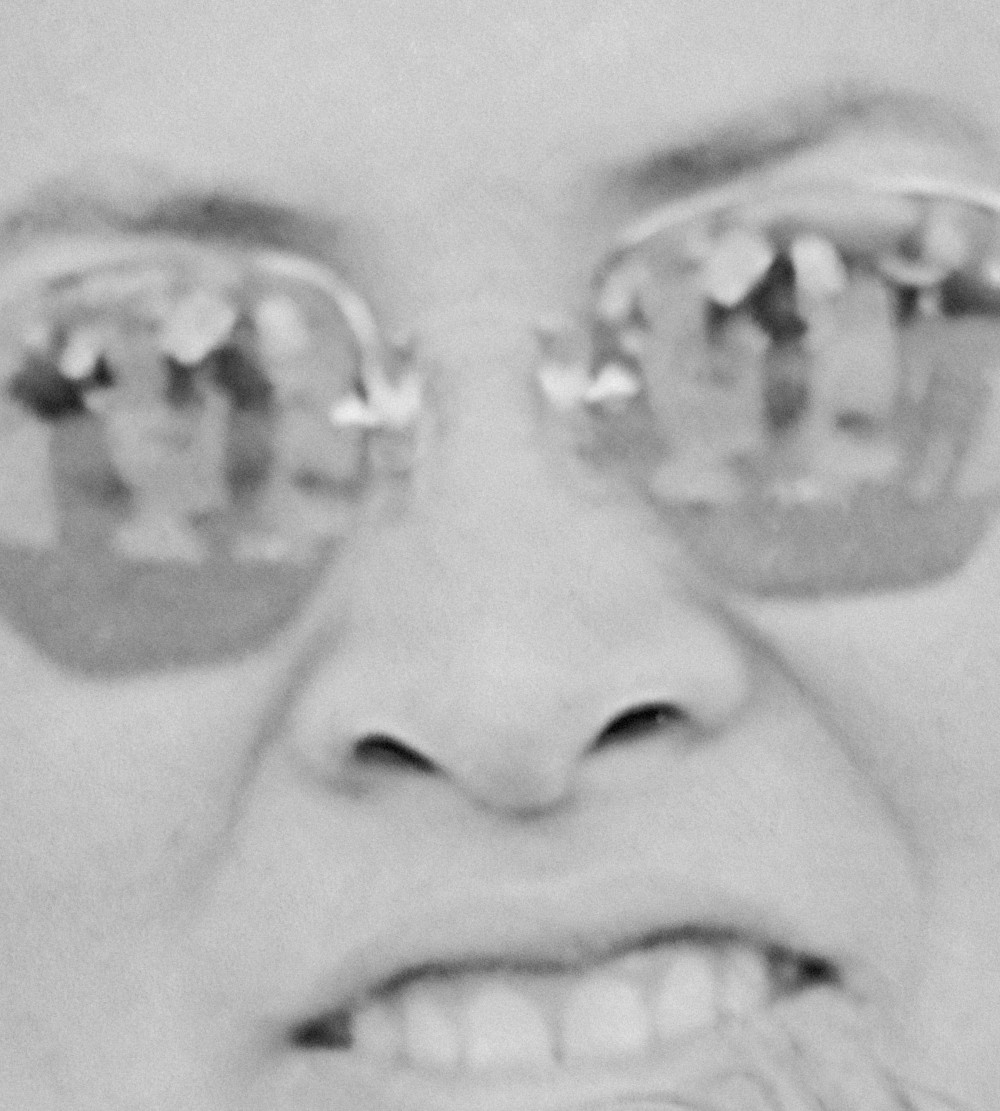
A young girl stands in front of her family as she waits for the bus that will take her to camp. She appears to be smiling; but when you crop the photograph and zoom in on her eyes, you realize that she is not. Photograph by Dorothea Lange, Hayward, California, May 8, 1942. Courtesy of the National Archives and Records Administration, ARC identifier 537509.
A photograph is a contract between photographer and subject. Once, after the photographer Cartier-Bresson, well-known for his candid street photography, took a portrait of a woman, she asked if he would show her the photograph before he printed it. “Don’t you trust me?” he responded. He meant to say, perhaps, that no contract was necessary between them. Things don’t work that way anymore. The kinds of photographs Cartier-Bresson took back then are unthinkable nowadays, when the need for an explicit agreement compels most photographers to rely upon professional models. Under these conditions, the event of a photograph becomes a kind of performance. Suffice it to say that a photographer can only snap the shutter after a subject has agreed to be photographed.
Allegedly, the contract involves two parties: the photographer and the subject. But what became clear to me from observing the figures reflected in the young girl’s eyes, as well as the expression on her face, was the presence of third parties—people standing behind the photographer, watching the contract take shape. There is more to this scene than one might ordinarily imagine. It is as if the photograph itself were warning us: “This isn’t such a simple story.”


One major shift that occurred in the field of European art at the beginning of the modern period was the emergence of mirrors as objects represented in paintings. Mirrors appear, for example, in Diego Velázquez’s “Las Meninas,” Johannes Vermeer’s “The Art of Painting,” and Jan van Eyck’s “Arnolfini Portrait,” among other works. “Las Meninas” has been singled out as one of the first paintings to include a self-portrait within its composition. It is for this reason that Michel Foucault, in his magnum opus The Order of Things, invokes “Las Meninas” in discussing the birth of individualism and, by extension, modernity. Before “Las Meninas,” he argues, the point of view in most paintings had been aligned with that of God. Painters’ realization that they could inscribe themselves into the scene of a painting, therefore, constituted a major discovery.
There are no mirrors in the photograph of Lange’s reproduced in Fig. 5; neither are her subjects’ eyes close enough to the camera to become reflective surfaces. What struck me in this work, the moment I first saw it, was the clear, penetrating gaze of the woman sitting midway up the stairs, the mother surrounded by her children. That look of hers pierced right through the camera’s lens, through the gaze Lange was directing at her—it was akin, somehow, to the smile of the merciful Kannon Bodhisattva. The structure of the image immediately reminded me of Velázquez’s “Las Meninas,” in which multiple gazes are layered on top of each other: first the king and queen, who are only visible to us through their reflection in the far mirror, then their child heirs, and then the painter himself, who is turned toward us, paintbrush in hand. And then there is you, the viewer, suddenly struck by the realization that you are the one whose portrait is being painted, that it is you who occupies the position of the king and the queen. Something similar happens in this photograph. It seems already to have incorporated the viewer, so that even 80 years later you become the intended recipient of the mother’s gaze.
First, we note that this photograph was taken in front of the San Francisco Japanese American Citizens League building. The people in the image are here because they are registering to be evacuated. They are preparing to cut their ties with the past, leave behind their land and their homes and their cars, arrange their finances. They have not been told anything about these so-called camps, where they will soon be taken and locked up. Their past evaporating before their eyes, the future as yet invisible, they are suspended mid-air in an uncertain present as they wait for the bus to arrive the following day. Imagine being in this suspended state, and then suddenly being approached by a group of white photographers—and not just one. This was the context for Lange’s photograph.
The thing that really stayed with me when I first came across this photograph was the mother’s smile. How did she manage to muster a smile like that amidst the chaos of packing bags, registering her family members, preparing to board the bus? Was it the photographer’s skill, or her own superhuman strength that drew it out? There is something cruel about the skill and cunning of a photographer homing in on their target. Quietly, carefully, the photographer approaches her, like a predator trying not to startle its prey.


Series 1: Clockwise from top left: Dorothea Lange photographing a migrant child in California 1935. Photograph by Rondal Partridge. Gelatin silver print. Courtesy of the Rondal Partridge Archive; A page of notes by Dorothea Lange. The Bancroft Library, University of California, Berkeley. San Francisco, California, April 25, 1942; Photograph by Dorothea Lange. Gelatin silver print; mount 24 x 30 cm. Library of Congress 2021650557. San Francisco, California, April 25, 1942; Photographs by Dorothea Lange. Negative. National Archives 536456, 536457.
We can see from the photograph that Lange was standing at the bottom of the stairs when she took it. The film is 6 × 6, meaning she was not using her usual large-format 4 × 5 Graflex camera. Instead, she was probably using a Rolleiflex. This kind of camera is sometimes referred to as a twin-lens reflex camera: the bottom lens shoots the image, while the top acts as a finder. The finder has a 45-degree mirror inside, and you peer down into it from above as you decide how to frame the picture. This is exactly what Lange must have been doing when she took this image. She pressed the shutter, that is to say, without ever making direct eye contact with the mother. Another feature of the Rolleiflex is that the position of the lens is lower than the eye—making it well suited to this kind of shot, angled up from below.
If you look carefully at the eyes of the five people in the image, you will see that the only ones looking directly at the camera are the mother and the child to her right; and that the friend, as well as the child sitting to the left of the mother, are looking at someone behind the camera. Someone else besides Lange must have been standing nearby. The friend is


If we examine in detail every photograph that was taken on the morning of April 1, we find that some of the same figures reappear across multiple images, sometimes with different people. Those we assumed at first to be family members turn out not to be; while those we thought were on their way to the camps are actually waving goodbye to relatives who have boarded the train. Things that cannot be understood from a single photograph in isolation become clearer when seen across multiple images, which gradually form a larger context and story.
“A little girl is sitting alone on top of a suitcase. She is not smiling. In her hand, she holds a half-eaten apple.” The photograph to which this caption corresponds, of a two-and-a-half-year-old girl named Yukiko, has become a sort of emblem of the Japanese American incarceration—it appears, for instance, on the homepage of the National Archives website. In addition to being a striking image, it also allows the viewer to envision very clearly what the experience of being forcibly removed must have been like—it matches, in other words, our contemporary perspective on the trauma of the Japanese American incarceration.


Certain details in the two photographs by Albers and Lee make it seem even more likely that Yukiko was singled out by the press. The people in the background are different in each photograph, suggesting that some time has elapsed between the first and second. What’s more, the furoshiki in the upper left corner is identical to the one in the lower right corner of Fig. 17, indicating that all three were taken in the same general area.
In 2005, the Pacific Citizen newspaper ran a story about Yukiko, then a sixty-year-old woman. In the story, Yukiko recalled how she had visited Manzanar later in life, but didn’t remember anything about this day, except for one thing: her mother telling her, “Sit there and don’t move. Here’s an apple!” Yukiko’s mother does not, however, appear in the picture. Could this explain the troubled expression on Yukiko’s face? Had her mother left her alone momentarily? If so, then perhaps Yukiko was feeling something closer to fear than loneliness. Comparing the two photographs, I can’t help feeling that Lee captured the scene much more fully than the press photographer Albers did. In Lee’s representation, the little girl is not looking at the camera—she is looking off into the distance. Perhaps she is searching for her mother.
Time is a funny thing. It was Albers’s rather ordinary photograph, rather than Lee’s excellent one, that became famous. Presumably this is because, while Lee’s photograph was shut away in an archive, Albers’s was immediately published in newspapers and widely circulated. Lee’s picture, with its gentle gradations, has a freshness to it, almost as though it was taken yesterday. It conveys the atmosphere of the scene so vividly that the viewer comes to see the little girl not as an abstract icon of the incarceration, but as a living part of that unfolding moment—almost as if she had been frozen in time.


If you look closely enough at the photographs depicting the events of April 1, 1942, you can more or less make out the order in which they were taken. You can imagine people moving from place to place as time passes, like characters in an epic poem. Now, thanks to 3D modeling, we, too, can lose ourselves in the distant time and space they inhabited, though we are separated from them by a distance of 80 years. How we think about this depends, I believe, on the stance we adopt toward this engagement with the past. Do we enter that world as complete outsiders? As tourists? In conceiving a work like this, it is crucial to think about the role the visitor plays.


One person worth considering, it seemed to me, was the documentary photographer Russell Lee. What was he thinking as he stood there holding his camera, caught between his position as someone employed by the government and the Japanese American people who were being sent off to concentration camps before his eyes? Part of my intention in this exhibit was to offer people a chance to consider, and to experience, what a photographer like Lee might have been thinking and feeling at the time. In the exhibit, this became possible through a film created with 3D renderings.

Destiorestem vernatq uiaspit a nimporem. Sed ma volorep udipsun tecaecto magnis rempor reped quundip sanihillo consequas de quaepudi qui non porae endel ipicium repudig nihilibus everiostis autati quunte occature quidel ium quidunt adia vel maximagnimet aut exerem utem faccum quatur sunto eum antem dolupta tecaborro id quia postis ad.
In the final room of the exhibit, visitors are offered a chance to use a camera themselves, though not the small-scale Contax camera manufactured by Zeiss Ikon that Russell Lee used, but rather a Graflex Super-RB camera of the sort beloved by Dorothea Lange—who, it should be noted, was not part of the scene at the Old Santa Fe station. The cameras visitors are given are not originals; they are replicas with AR technology embedded inside them. With these cameras in their hands, museum visitors and invited to put themselves in Lange’s shoes, viewing the scene from her perspective, through the viewfinder, so that they can enter into the scene where the events took place, into that epic poem of the Old Santa Fe station.


In 1942, the building that housed Nishi Hongwanji temple was located across the street from a block of warehouses, on East 1st Street and North Central Avenue. You can still see it there today, though now it is an annex of the Japanese American National Museum (JANM). The street in front of the old temple has since been closed off to traffic, turned into a kind of public square where pedestrians can wander. If you stand on the corner facing the plaza, with the former Nishi Honwanji Temple to your left, you see the annex of the Museum of Contemporary Art (MOCA) straight ahead, while JANM is off to your right. We were fortunate to be able to use this location for the AR installation that is the centerpiece of BeHere / 1942, which is an imaginative recreation inspired by many photographs, particularly the photograph shown below. This was fortunate both for historical reasons, and because it gives visitors to the exhibit room to move around safely as they use the AR app. Although it isn’t an exact reproduction of the forced removal in 1942, the scene is probably about as close as you can get as a symbolic representation of an event that took place in multiple locations all over the city of Los Angeles.

Though I was as thorough as I could possibly be in researching photographs of the forced removal, there was no way to derive enough information from them to reproduce the event exactly as it was, and I had to rely heavily on my imagination. For this reason,I also drew on photographs of the forced removal in the San Francisco area. We recruited participants who roughly matched the age and demeanor of first-generation Japanese Americans from the period, created simple scenarios, and filmed them.
The filming was done in two different studios using a new technology called volumetric capture: Crescent Corporation in Tokyo, and 4DFun Corporation in Los Angeles. The process involved filming participants with multiple cameras positioned in circles at different heights around a specialized studio—32 cameras in Los Angeles, 48 in Tokyo—and then combining the data to form a string of sequential 3D models. This is the first time anywhere in the world that volumetric capture technology has been used on a large scale in a public art installation.


An augmented reality (AR) rendering of the bus used to transport Japanese Americans from Los Angeles to Manzanar. An augmented reality (AR) rendering of the bus used to transport Japanese Americans from Los Angeles to Manzanar.
The buses in front of Nishi Hongwanji Temple that appear in those famous photographs from Toyo Miyatake Studio were long-distance buses belonging to a company called Santa Fe Trailways. The company’s pamphlets advertised the bus as having a low center of gravity, offering a much improved, more comfortable riding experience; safe glass windows that provided a wide, spacious view; powerful air brakes; and the world’s first air conditioned cabin. The buses in the photos seem to be a 1937 model manufactured by ACF Brill. Though you can’t tell from the black and white photograph, pamphlets and timetables show that the paint on the exterior was cream yellow and red. Usually, a bus’s destination would be indicated by a sign on the front, but in the Toyo Miyatake Studio photographs the sign is blank. In some pictures of the forced removal the sign says SPECIAL. It is a subtle way to frame what is happening: a pleasant trip on a bus headed to a special location.


Generally, promotions that use new visual technologies such as virtual reality (VR) and AR follow the logic of games and movies, and companies emphasize how ‘fun’ the experiences they offer are. Both games and movies present us with an unreal amount of information, thus creating a sense of total immersion; there is, however, something frightening about the experience of being embedded in a 360-degree environment, since you can never see what is behind you. You feel as though you are surrounded by something or someone, as if you are being observed. In this feeling of total containment, I sense a certain resemblance to what Japanese Americans must have felt as they waited for the buses to arrive. Smartphones are convenient, to be sure, but they have also paved the way for an increasingly sophisticated surveillance society.

Not only does the 1942 incarceration of Japanese Americans continue to stand as a warning to us about racism and the maintenance of a democratic society; it also, I think, links up directly with other contemporary problems, such as media’s tendency to create hierarchies, and the fundamental, incredibly important issue of how we look at others.


